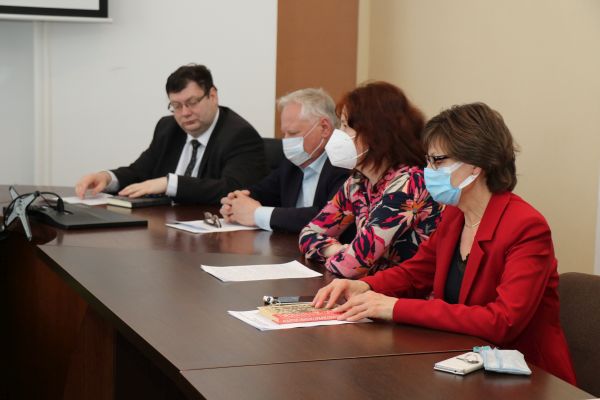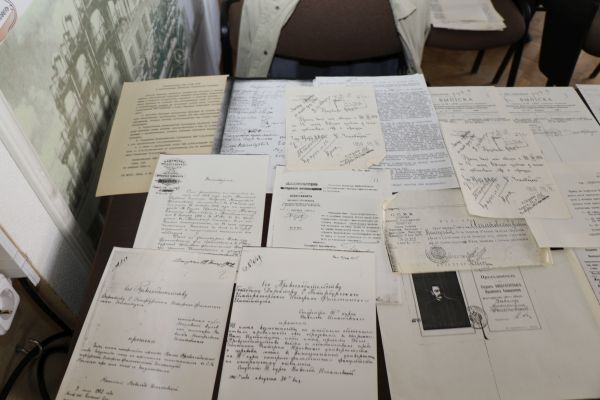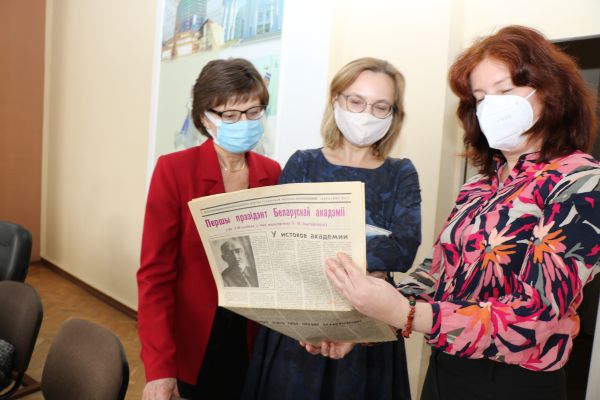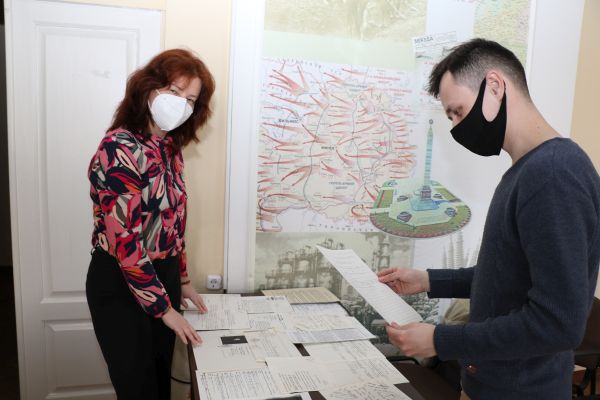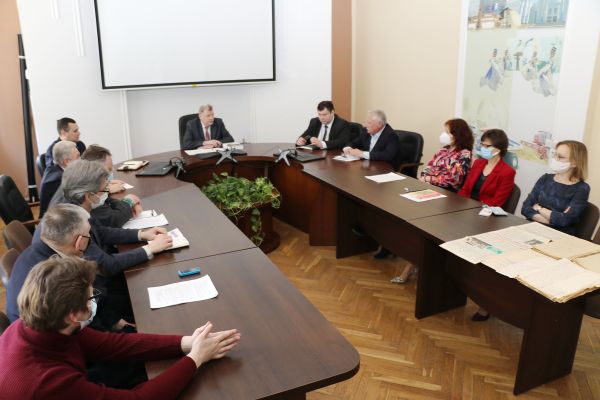
On April 19, 2021, a round table dedicated to the 140th anniversary of the birth of the first president of the Belarusian Academy of Sciences, Usyevalad Makaravich Ihnatouski, was held at the Institute of History of the NAS of Belarus. The organizers of the event are the Institute of History of the NAS of Belarus, the Department of Humanities and Arts.
Usyevelad Makaravich Ihnatouski (4/19/1881, village Takary, Kamenets District, Brest Region – 2/4/1931), historian, public and political figure, academician of the National Academy of Sciences of Belarus (1928), academician of the All-Ukranian National Academy of Sciences (1929).
— Graduated from the University of Tartu (1911).
— In 1914 – 1920 he was a teacher, director of the Minsk Teachers’ Institute.
— In 1920, a People’s Commissar of Agriculture of the BSSR, in 1920 – 1926 – a People’s Commissar of Education of the BSSR. Since 1921 professor, dean, deputy rector of the Belarusian State University.
— Since 1925 – the Head (since 1927 the President) of the Institute of Belarusian Culture (Inbelcut), in 1929 – 1931 the President of the Belarusian Academy of Sciences and at the same time director of the Institute of History of the Belarusian Academy of Sciences.
— In 1925 – 1927 he was a member of the CEC of the USSR, in 1922 – 1930 he was a member of the CEC of the BSSR, in 1924 – 1930 he was a member of the Presidium of the CEC of the BSSR.
Studied the history of Belarus. Published a number of major monographic studies, including one of the first generalized works on the history of Belarus – “A short sketch on the history of Belarus” (1919; 5 editions, 1991). His monograph “1863 in Belarus: An Essay on Events” (1930) became the first major study of the history of this uprising in Belarusian historiography. He paid considerable attention to the history of the October Revolution and the first years of Soviet power in Belarus. He is responsible for the development of the concept of national history, taking into account the Marxist-Leninist methodology of history.
He was author of 40 scientific and scientific journalistic works, including eight monographs.