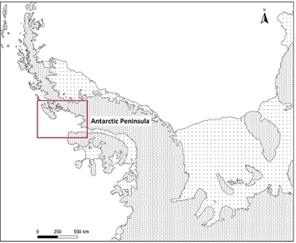
New data has been obtained at the Institute of Nature Management of the National Academy of Sciences of Belarus by Professor Sergey Kakareka, Head of the Transboundary Pollution Laboratory, Doctor of Engineering, Professor, according to the results of the landscape-geochemical studies on the islands of Margaret Bay (West Antarctica), which the scientist conducted during participation in the 4th Turkish Antarctic Expedition (TAE-IV) in February–March, 2020.
The results of the study of macro- and micronutrients in the snow and freshwater reservoirs of the explored islands are published in the latest issue of the scientific journal Polar Science*. This is the first publication in the authoritative international edition, devoted to the hydrochemistry of fresh waters of these islands.
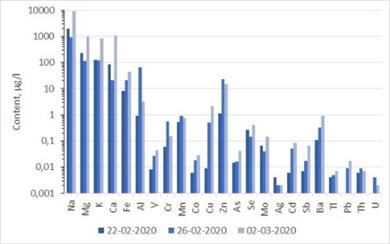
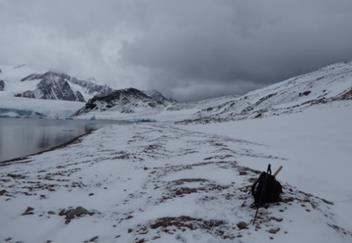
Research of the Belarusian scientist on the Antarctic Peninsula included sampling of the water bodies, streams and snow in different parts of Dismal and Horschu Islands to study their microelement and isotope composition, description of the landscape features of the area, vegetation and soils. Special attention was paid to the parallel sampling of the freshly fallen and «old» snow to indicate the contribution of the regional and local natural and anthropogenic factors to its elemental and isotopic composition. It was found, in particular, that the variability and average concentrations of the macro- and microelements in the freshly fallen snow are significantly higher than in the «old» snow. All types of the water samples have the high relative concentrations of the sodium, which confirms the dominance of the marine aerosols as a source of their input. High coefficients of fresh water enrichment (EFc >100) with zinc, cadmium, selenium, and antimony indicate the anthropogenic nature of these elements, mainly with a long-range transport of the air masses.
*Kakareka, S., Kukharchyk, T., Kurman P. Trace and major elements in surface snow and fresh water bodies of the Marguerite Bay Islands, Antarctic Peninsula // Polar Science. 2022. Vol 32. 100792 https://doi.org/10.1016/j.polar.2022.100792,