
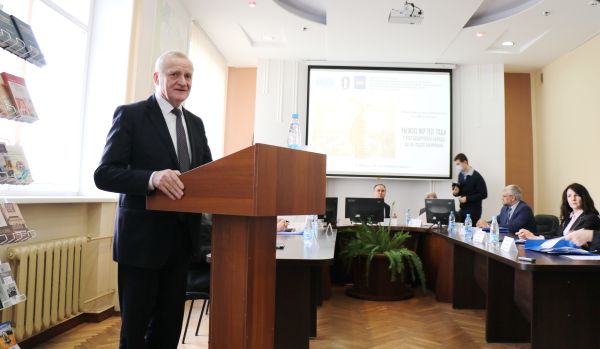
On March 18, 2021, the Institute of History hosted the grand opening of the International Scientific Conference “The Riga Peace of 1921 in the Fate of the Belarusian People (to the 100th Anniversary of conclusion)”. The organizers of event are the Institute of History of the NAS of Belarus and the Academy of Public Administration under the aegis of the President of the Republic of Belarus.
At the opening ceremony, the Chairman of the Presidium of the NAS of Belarus Vladimir Gusakov noted: “Today’s conference, dedicated to the tragic date for our people – the Riga Peace, has a significant, very important meaning. I insist that we hold as many as possible that will reflect the true history of our land. Without exaggeration, the Belarusian statehood is the most ancient statehood in Europe, no matter what they say. And about this it is necessary to talk more widely, starting from the history of such periods as the Polatsk and Turaw principality, the Grand Duchy of Lithuania, the Polish-Lithuanian Commonwealth, etc. At the present stage, Belarus has the necessary statehood, borders, preserves its culture, tradition and history. We need to boldly defend the national interests, justice and truth of the Belarusian people”. During his speech, Vladimir Gusakov spoke about plans to expand the activities of the Institute of History and the creation of several institutes on its basis, united into a single center. In addition, in light of the global challenges facing the country’s researchers, the Chairman of the Presidium instructed the Institute’s of History specialists to develop an encyclopedia of Belarusian statehood on the basis of a five-volume scientific publication on the history of Belarusian statehood.
On March 18-19, 2021, the Institute of History together with the Academy of Public Administration under the aegis of the President of the Republic of Belarus held a landmark International Scientific Conference “The Riga Peace of 1921 in the Fate of the Belarusian People (to the 100th Anniversary of conclusion)”. The forum discussed the fate of the Belarusian statehood in the context of the geopolitical challenges of 1918-1923, the Polish-Soviet war of 1919-1921. They also assessed the role of the Riga Treaty in the fate of the Belarusian people and in the nation tradition. In addition, among the tasks of the forum is to improve the interaction of academic and university science on topical problems of the development of national socio-humanitarian studies, organization and management of the creative initiative of students on topical issues of studying the history of Belarusian statehood.
*On March 18,1921, in Riga, after the Polish-Soviet war, the delegation of Poland, Soviet Russia and the Ukranian SSR, without taking into account the interests of the Belarusian people, signed a peace treaty. The signed treaty the resulted in heavy material losses. According to the treaty, almost half of the ethnic Belarusian territory occupied by Poland. Although the Riga Peace Treaty legally secured the independence of Soviet Belarus and guaranteed the Belarusians national and cultural rights as part of the Polish state, in the long term it was not possible to comply with the terms of the treaty on ensuring spiritual and cultural development, did not contribute to the unity and security of the peoples of Eastern Europe, which was especially clearly manifested in September 1939.