
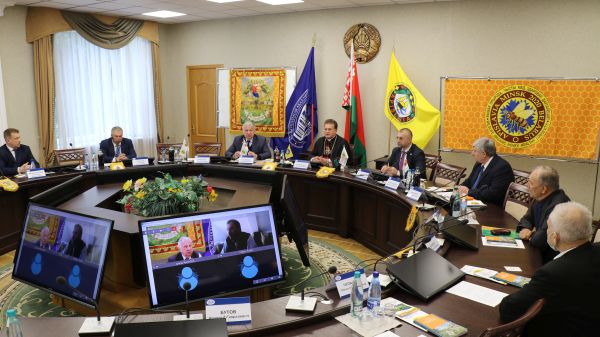
On May 20, 2021, the opening ceremony of the XXIII Congress of the Federation of Beekeeping Organizations “Apislavia”* was held at the NAS of Belarus.
This is the first such large international event in our country dedicated to the problems of beekeeping and the use of its products, wide interaction of specialists and scientists in this industry. Leading beekeepers of Belarus, Russia, Moldova and other countries take part in the Congress. The Congress is held with the real presence of participants and in online format. During the forum, experts will share their experience in scientific support of the industry and the use of its products, including the latest technologies for maintaining and obtaining beekeeping products. Beekeepers will consider problematic issues, outline ways to solve them, and also define the tasks of science in this most important branch of the agro-industrial complex.
In the Republic of Belarus, as of January 1, 2021, there were more than 210 thousand be families, including: almost 33 thousand – in agricultural organizations, more than 4 thousand – in peasant farms. These are great prospects for obtaining high-quality bee products: Honey, pollen, royal jelly propolis, bee venom, wax.
As the Deputy Chairman of the Presidium of the NAS of Belarus Petr Kazakevich, speaking at the opening of the Congress, noted, “it is important to expand the sowing of honey crops in order not only to develop beekeeping, but also to increase the productivity of agricultural crops as one of the solutions of the Doctrine of the country’s food security”. Petr Kazakevich noted the active work and significant achievements of Belarusian scientists in the development of beekeeping, the practical use of its products. He gave specific examples: “The Institute of Beekeeping on the NAS of Belarus is developing a system for using bees to increase the yield of fruit and berry agricultural plants, new technologies for obtaining beekeeping products are being studied. The institute of Genetics and Cytology has implemented a pilot project to find effective DNA markers to characterize the genetic diversity of honey bees in Belarus, within the framework of which molecular genetic analysis was carried out and subspecies of bees, their purebredity and the degree of cross breeding bird determined. At the Institute of Experimental Veterinary Medicine named after S.M. Vyshalesky, new methods of treating sick bees have been found. The Institute for Plant Protection has tested the insecticidal qualities of herbicides. Scientific research on the selection of new melliferous plants for beekeeping in Belarus is planned in the Central Botanical Garden of the Academy of Sciences. In addition, a decision was made to create and expand existing beekeepers in a number of organizations of the Department of Agrarian Sciences and the Department of Biological Sciences of the NAS of Belarus. Therefore, we are going to make a significant contribution to this good case”.
Participants of the Congress and the International Scientific and Practical Conference will visit the flowering gardens of the RUE “Institute of Fruit Growing” of the NAS of Belarus, as well as the beekeeper on the Belarusian beekeepers and the Ministry of Forestry.
*“Apislavia” is a Federation of beekeeping organizations in Europe and Asia, founded in 1910. This is one of the largest platforms for discussing the common successes and problems of beekeeping in Eastern, Central Europe and Eurasian tspace. Every two years the FBO “Apislavia” holds an international beekeeping Congress in different countries.